Nothing on my mind

I’ve been thinking more about nihilism.

Consider a schematic case in which your total evidence is E and you are trying to determine whether you should believe P, believe not-P, or suspend judgment. Uniqueness is the view that exactly one of these choices would be rational. Permissivism is the view that more than one of these choices would be rational. Nihilism is the view that none of these options is rational.1

That’s how I posed it in an earlier post, anyway. Then I stumbled across a forthcoming article by Elizabeth Jackson & Margaret Greta Turnbull. Nodding to Feldman, they define Uniqueness as “the thesis that there is at most one rational doxastic attitude toward a proposition.” In my terms, this is the disjunction of Uniqueness and Nihilism. Ugh.

Continue reading “Nothing on my mind”
Why evidentialism is tantamount to scepticism

Over on Facebook, Carl Sachs offers a send-up of evidentialist reasoning. In the comments, I boil the argument down to this:

  1. Only believe on the basis of univocally sufficient evidence.
  2. Evidence is never univocally sufficient.
  3. Therefore, don’t believe!

It’s valid, but are the premises true?

Continue reading “Why evidentialism is tantamount to scepticism”

Rationality nihilism

I’ve been teaching epistemology this semester, and we’ve recently been talking about permissivism. The setup is this: Let E be the total evidence, and let P be some claim. One might believe P, believe not-P, or suspend judgement; call these doxastic attitudes towards P.

With that formalism in place, we can define Uniqueness: Given E, there is exactly one doxastic attitude that one may rationally adopt toward P.

In the article I’d assigned for class, Permissivism is defined as the negation of Uniqueness. The idea is that there are at least some situations in which, given E, one might rationally adopt different doxastic attitudes.2 For example, it might be rational to find the evidence convincing (and believe P) but also rational to be unconvinced (and suspend judgement).

Students found the readings less than clear, and I was trying to concisely formulate the opposition on the whiteboard. I stopped mid-sentence when I realized that I couldn’t just define Permissivism as the negation of Uniqueness. There’s a third possibility!

Call this Nihilism: Given E, there is no rationally permitted doxastic attitude that one may adopt.

I don’t know of an epistemologist who explicitly formulates Nihilism, nonetheless one who advocates it. I have a perverse impulse to write something arguing for it, just because it is a logically possible position, but that way lies madness.3

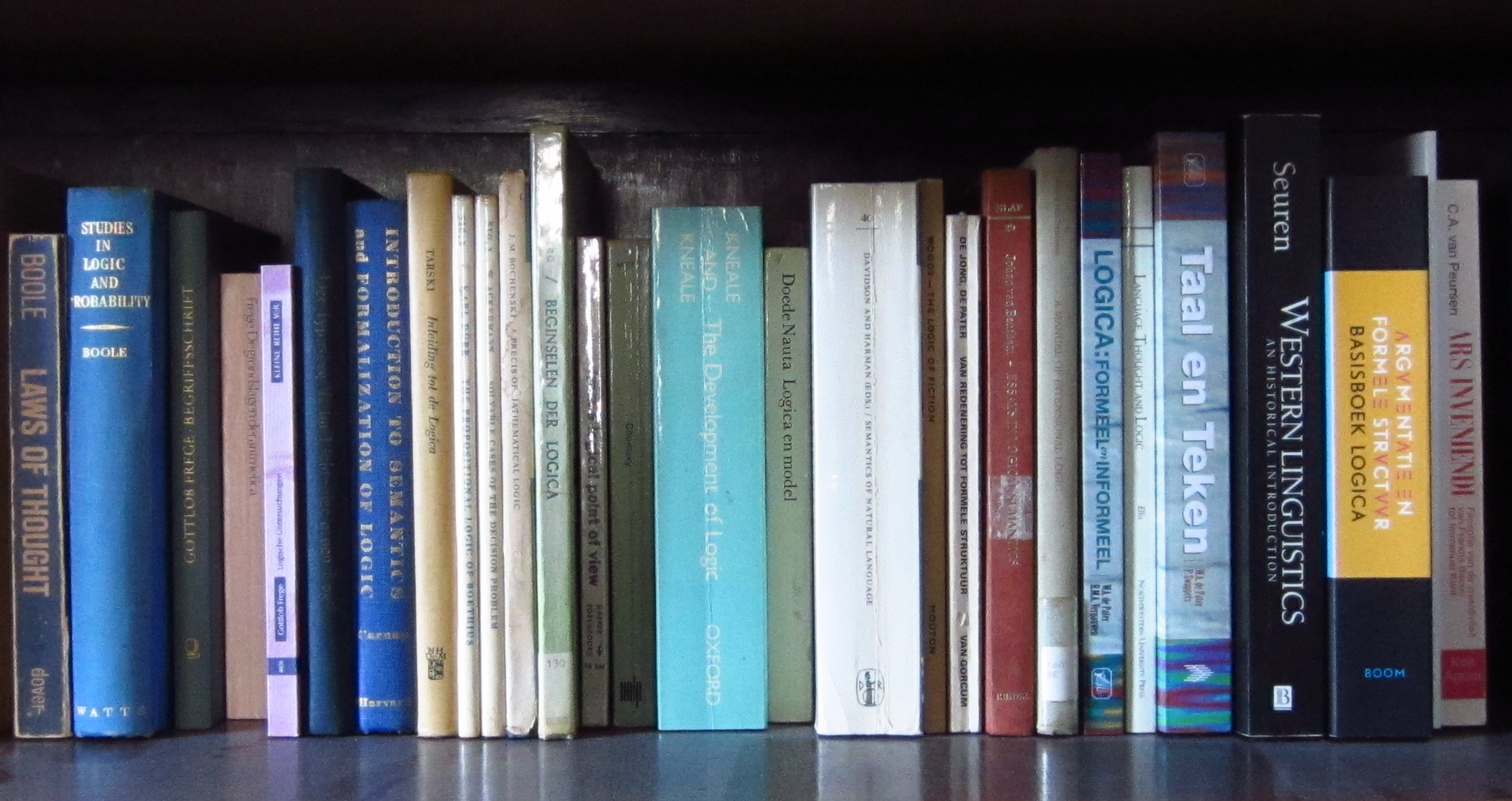
Picture: Some logic books.

Constitutivism and the foundations of ethics

My colleague Ariel Zylberman has organized a one-day academic workshop here at UAlbany, coming up on March 15. The topic is constitutivism about moral norms— the view that norms are presumed by the very nature of action and agency.

The powerhouse list of speakers comprises Matthias Haase (Chicago), Michelle Kosch (Cornell), Sharon Street (NYU), and David Velleman (NYU). The official commenters will be Hille Paakkunainen (Syracuse), Francey Russell (Yale), Jason D’Cruz (UAlbany), and Paul Katsafanas (Boston University).

If it sounds like your kind of thing and you might be in the capital region in mid-March, more information and the registration form are at the workshop webpage. It’s a free workshop, but Ariel is asking that attendees register by March 1.

conference poster for constitutivism workshop

When artists are terrible people

Aesthetics for Birds has reposted a symposium from Daily Nous on the question of whether we can separate considerations about artwork from considerations about the artist who created it. By way of my summer reading and current procrastinating at the end of the semester, here’s a comment on the topic.

Continue reading “When artists are terrible people”

What’s so funny about credence, love, and understanding?

I can’t tell if Suki Finn’s Beyond Reason: The Mathematical Equation for Unconditional Love is meant to be taken seriously or not. Irony on the internet is usually indistinguishable from earnestness. The fact that there is an addendum with a mathematical proof may indicate that it’s serious, but maybe it’s a droll bit of farce?5

I read it with interest, in any case. Finn offers an analysis of conditional and unconditional love that is modeled on conditional and unconditional credence. As I’ve discussed in some recent posts, I think that recognizing the difference between conditional and unconditional value is crucial for understanding the relation between values and belief.6

Continue reading “What’s so funny about credence, love, and understanding?”

Hot takes on Controversial Ideas

I’ve run into lots of posts and news about The Journal of Controversial Ideas, both from philosophers who you’d expect to be talking about this thing and elsewhere.7 The journal, organized by Jeff McMahan, Peter Singer, Francesca Minerva and others, is meant to be a forum for scholarly papers which scholars would be afraid to publish elsewhere. To shield authors from blowback, all the papers will be published anonymously.

A. Lots of people have commented that the new journal is likely to be a cesspool of racism, sexism, and other terrible views which people like to pretend they can’t talk about. I suggest this modest principle: If the president can tweet a view, then there are already sufficient venues for its expression.

Continue reading “Hot takes on Controversial Ideas”

Books from #PSA2018

Yesterday I traveled back from the Philosophy of Science Association biennial meeting in Seattle. I got to hang out with a bunch of friends in the discipline and meet lots of new ones. There are other people who I saw in passing, had every intention of catching up with, but then didn’t see again in the throng.

This was, I’m told, the largest PSA meeting ever. Part of that is driven by the increased number of ways for people to be on the program. This was only the second PSA with a poster session, but the poster session was so large that I didn’t see everything before time was up.

One thing I always enjoy about the PSA is the book exhibit.8 Although I mostly consume philosophy in electronic form these days, I always come home from the PSA with a few dead-tree books. Usually these are things I hadn’t even known about beforehand, and this time there were two of those.

Continue reading “Books from #PSA2018”

Revising details in forall x

I’m teaching Introduction to Logic for the first time in several years. The course text is my own forall x. It’s always been an open textbook, even back before I had good vocabulary for explaining what that means. But now it’s available from SUNY OER Services, and they’ve partnered with SUNY Press so that my students are able to buy a hardcopy from the campus bookstore for just $8.50.

Working through it this time, I’ve hit a couple of things which I am considering changing.

Continue reading “Revising details in forall x”